For UK restaurant and bar managers watching their beverage sales shrink
Your wine sales are flat. Your cellar is full. The reason is not what you think.
Before you blame the season, staff, or customers, know this: a structural reason is stopping your wine list from selling, you did not do anything wrong. You were given the wrong frame for the problem.
In the video, Marco, our Wine CFO breaks down exactly what's happening in United Kingdom, what it means for your venue, and what you can do about it.
In a year of 2,900+ UK hospitality insolvencies, "wait and see" is not a strategy
The numbers no one wants to look at.
In 2025, more than 2,900 UK hospitality venues filed for insolvency. The highest number since 2011. Roughly +30% versus 2024. Between January and September alone, 872 insolvencies, that is +26% year on year. Data: KOF Institute and GastroSuisse joint Branchenbarometer; MarketScreener Schweiz, October 2025; Watson, October 2025.
Look at the names you saw in the press. Restaurant Strauss in Manchester, 15 Michelin points. Paradies in Birmingham, 15 GM points. Z am Park in London. Maiengrün in Hägglingen. None of them were doing badly six months before they closed.
Each of them ran a beverage program, but with a leak nobody noticed before it was too late.
In the same survey, only 20% of UK operators rate their current business situation as "good."
23% rate it as "bad." 57% sit in "satisfactory", which is the polite UK word for "we are still open and we are watching every cover." Average revenue declined 2.6% for four consecutive quarters.
That is the macro frame. Now let's look at the wine problem.
By-the-glass (BTG) should account for 60-70% of wine revenue in a typical wine-led venue. Those are industry benchmarks, not aspirational targets. (Wine With Seth, BusinessDojo restaurant industry data.)
If only 3 or 4 every 10 customers buy a glass of wine, if your beverage gross profit margin is 50-60% instead of 70-80%, that is not an off quarter. That is a structural gap.
And every additional month you operate inside it, the gap compounds against the same macro pressure you already saw in the figures above.
If your high margin bottles are sitting on the shelves, gathering dust, the wine list is the problem.
You already know the symptoms: covers are steady, wine sales are not. Mid-tier and premium bottles, that would earn you a profit, sit in the cellar like collecting dust, that is just your money that you cannot touch.
Guests increasingly default to tap water, a Coca-Cola Zero, a matcha. You have tried discounting the by-the-glass selection, you have tried a wine night, you have asked the supplier for new bottles. The sales have not moved.
That is not bad luck. That is a leak.
A leak that compounds every month you keep running the same list, in a year when UK hospitality insolvencies ran past 2,900 filings, not a market that waits politely while the list stays unchanged.
The market is not going to wait for you to figure this out. The cellar will not pour itself. And every quarter you stay on the same list, the math gets worse, not because you are doing more wrong, but because the leak was always there and you only saw the symptom.
The wine list you are running was not designed by you. And the people who designed it were paid by someone else.
Stop for a second and ask yourself an uncomfortable question.
Who actually built your current wine list?
If you are like most managers I work with, the answer is some version of: "The supplier rep helped me put it together. They came in, brought a tasting kit, suggested a few labels, and we went from there. It was free."
That sentence — "it was free" — is the most expensive sentence in your P&L, your results
Here is what nobody told you:
A wine supplier earns margin on what they ship to the venue. They earn nothing on what the venue then sells through. Their financial incentive is moving inventory off their shelves and into your cellar, not moving inventory off your wine list and into your guests' glasses.
Those are not the same goal. They are not even adjacent goals. They are opposite goals.
This is not a moral failure on the supplier's part. Their business model is simply to sell wine, it is their role.
They behave as any merchant should. The problem is that your wine list ended up positive for the supplier and negative for your beverage sales.
In the US, where it’s easier to end up in court, there was a same structural conflict of interest documented across F&B sectors at the highest visible scale.
The New York Law Journal called it "Vendor Rebates: Franchising's Dirty Little Secret" in a December 2019 piece. Subway booked USD 116 million in vendor rebates in 2019 alone — nearly double the previous year — primarily from a single beverage supplier; franchisee disputes followed because the franchisees realised those rebates were funded by paying higher prices on the inputs they had no choice but to buy. Tim Hortons franchise owners argued the same shape of thing in their own court documents. Eater and Restaurant Business Online have catalogued the pattern repeating across F&B segments. (Law.com / NY Law Journal Dec 2019; Restaurant Business Online; Eater June 2019.)
The UK situation is quieter. Nobody is suing anybody. But the mechanism is identical:
- The supplier sets up the list.
- The list is skewed toward the supplier's portfolio margins.
- The F&B manager inherits a list that looks free but is paid for, every month, in beverage gross profit that never shows up in the sales.
You did not see this as the cause because nobody framed it as a cause. It was framed as a favour.
Here is the chain you are running on, whether you saw it or not:
Operational Chain
How low wine sales are quietly manufactured step by step.
A supplier rep visits your venue. It feels helpful, free, and easy.
Critical error #1 Your list is built from their portfolio, not from the best wines available in United Kingdom for your business model.
Critical error #2 Prices are set with simple cost × markup (around 3x), with no per-glass margin strategy, no menu pairing, and no design that nudges higher-margin choices.
The list goes live, but no idea what happens next. You sell some bottle, earn some money, you don't know how much you sell and when.
Outcome
Guests choose the safest/cheapest glass.
Better bottles stay in the cellar.
Expected By-The-Glass programs remains far above real margin (50-60%).
You see low wine sales, but the root cause stays hidden.
The cause is not that people don't drink. These people you cannot convince them to drink wine.
The problem is that your wine loving guests find a wine list that is confusing and not made to make your best wine shine.
The supplier did exactly what suppliers do. The fault is not theirs and it is not yours. The fault is that nobody named the cause, so for years the only "solutions" anyone sold you were patches on the symptom.
You didn't fail. You were looking at the wrong problem.
Look back at every "fix" you have run on this problem in the last 24 months. I will list the ones I hear most often from UK operators on a Checkup call:
- "I'll push wine harder. Train the staff to recommend more bottles." — The staff are downstream of the list. They are not selling badly because they are lazy; they are selling badly because the list does not give them anything to recommend with confidence.
- "I'll discount the by-the-glass selection." — A discounted wrong-wine sells the same as a full-priced wrong-wine. Discounting subtracts margin without solving the structural problem.
- "I'll have a wine event. Bring in a producer." — One good evening of revenue. The list goes back to running on Tuesday morning.
- "I'll ask my supplier for new bottles." — Same supplier, same incentive. New bottles, same list logic.
- "I'll hire a sommelier." — A sommelier lives in pairing artistry and cellar depth. Both are real skills. Neither of them rebuilds the list as a financial instrument with engineered pricing per glass and emotional design that moves the average order higher up the list. (And in United Kingdom in 2026, with manager turnover running 38-55% across the sector, very few bistros can absorb the salary anyway.)
Every one of these moves operates on a symptom of a poorly built wine list. You were looking at the symptom, not the cause. The leak starts much earlier.
You did not fail. You were given the wrong frame for the problem. Inside the wrong frame, every move you made was rational. It just was not going to work.
There is exactly one place to fix this. Upstream. At the list itself. By somebody whose financial incentive is your beverage gross profit and not their inventory rotation, not their pairing reputation, not the size of your subscription.
Here is how we can fix your wine list, without changing your supplier or ordering new wine
My job is to look at this leak and help you fix them.
The menu is what brings you money, everything your guests can order is the menu.
Therefore your results will depend on the quality of the menu.
Not on the quality of the food, not on the quality of the wine.
Here are the steps we will take to fix your wine list:
- Diagnose — We start by auditing your current wine list and actual sales, not by theory, but by reviewing your real numbers. No shaming, no guessing, just a clear look at what's working and where the list is tripping up your profit.
- Engineer the profit structure — We rebuild the actual pricing ladder so your best bottles get visibility, emotional anchoring, and are priced for margin and speed, not dead stock. This step is not about adding new products, but extracting the highest value from what you already own.
- Design for decision-making — We remake the wine list layout and descriptions, so your staff can confidently recommend, and your guests no longer feel lost or hesitant to order higher-value glasses or bottles.
- Rapid test — no new wine ordered — You run the new list as a controlled experiment, with your existing inventory and current team. Nothing is forced on you. No new suppliers, no pressure to buy more. The goal: substantially higher wine profit with the stock you have.
- optimise for future orders — Only when the new approach proves itself in the real world do we create a reorder and supplier strategy — so you maximize vendor leverage and only bring in new bottles that drive profit, not just fill shelves.
This method was built in United Kingdom, For UK restaurant and bar managers, using the bottles and staff you already have. No supplier blame. No magic needed. Just finally running your wine list like the profit center it was meant to be.
All of this has is a method and it is called Wine Profit Engineering.
Wine Profit Engineering: a CFO-grade discipline applied to your wine menu
For me, your wine menu is a financial instrument. And I treat it like one.
Wine Profit Engineering is the method I built to detach you from the supplier list and to rebuild the wine list as an engineered profit centre.
With the main idea that we focus on your financial profit, not the suppliers.
This is not theory I made up.
Cornell Hospitality Research has documented for over a decade that strategically engineered menus can lift restaurant profits by 10 to 15% — without changing recipes, staffing, or advertising spend. Anchoring techniques alone lift average check by more than 10%. (Cornell Center for Hospitality Research; NineGuides menu pricing research.)
Cornell research by Lynn and Yang specifically on wine lists found four design choices linked to higher wine sales: include the wine list inside the food menu, drop the currency symbols, feature quality wineries, include a reserve section. (Cornell Chronicle, December 2009.)
Wine Profit Engineering is the application of that body of behavioural-economics research to the UK wine list, combined with independent selection (no supplier inventory bias) and operator-side training and tracking that makes the engineered list deliver itself across every cover.
Pillar 1
Strategic Pairing
Selection rebuilt from an independent supplier pool. No inventory bias. Each high-margin dish on your food menu paired with a wine that completes it. The selection logic is guest profile × concept × beverage gross profit target, not supplier portfolio rotation.
Pillar 2
Engineered Pricing
Per-glass and per-bottle margin calculated the way a CFO calculates contribution margin per unit. Opening price points engineered for psychological anchoring: a high anchor at the top, a sweet-spot pour where you actually want the order to land, a credible decoy in between. No more cost × markup. The price is a profit instrument, not an arithmetic output.
Pillar 3
Emotional Design
The architecture of the list itself: naming, sensory triggers, story per wine, sequence on the page. Designed to move the guest's eye from the cheapest by-the-glass option to the engineered sweet-spot. A list with no description and a flat price tells the guest one thing: "we don't care about what we serve."
It runs in three integrated pillars, with the wine menu gross profit as the measured outcome
The pillars do not work in isolation. The order is non-changeable.
Fix selection but skip margin architecture and you leave money on the table.
Price for margin, but if the list still reads like a supplier handout when the guest decides, you lose the order anyway.
Even careful “wine styling” around the wrong bottles for the kitchen still pushes the wrong product.
The compounding effect is the difference between a one-layer fix (a sommelier doing selection only, software counting bottles only, a supplier rotating inventory only) and an engineered system.
What it actually looks like: same wine, two different outcomes by design
Version A — the supplier-list reflex
Cabernet Sauvignon
GBP 12.-
Version B — Wine Profit Engineering applied
Château Saint-Pierre
A powerful and juicy Cabernet from the Médoc, Bordeaux, with notes of blackberry and vanilla and a smooth, memorable finish.
Pairs with: Entrecôte Parisienne
GBP 16 the glass
Cabernet Sauvignon, Bordeaux, France, 2019
Look at version A and what stops your eye is the price. GBP 12, is this wine good or bad? What should I pair it with? People don't know.
Look at version B and what stops your eye is the description. Then the pairing. Then the origin. The price arrives last, after the guest has already decided they want it. (This is the documented Cornell decoy + anchoring effect applied to a single line of a wine list.)
What do you think, if you ordered a entrecote, would you order wine from version A or version B?
Same wine. Different sales outcome. By design, not by accident.
Of course the final design depends on your menu design, and we don't have to write a one page description for every wine.
But the idea is to make the wine list a guided sales tool, not a supplier handout.
I can help you create a wine list that guides the guest's choice towards the higher margin wines, and that also enhances their experience.
Nobody wants to buy expensive wine, but people want to have a great experience.
You have to leverage that, and I can help you do that.
Of course, the Wine Profit Engineering takes time.
But the good news is that you can start today.
The first step is the Wine List Checkup. Free, until 31 October 2026.
You cannot engineer a wine list without data. The Wine List Checkup is the data collection.
Send us your wine list and we will analyse it and provide you with a report.
Here is what you will receive:
-
Wine report
A clear, plain-language analysis of how your current list is structured, where it leaks, and what to act on first.
-
Quick wins
Small changes you can implement before any larger engagement, often without reprinting the list or replacing the cellar.
-
Wine cost clarity
Per-glass and per-bottle margin worked out, so you see exactly where your beverage profit is ending up.
-
A live conversation with an expert
On call or on-site, walking you through the report, answering your questions, and laying out what an engagement would actually look like for your venue.
Usual investment
GBP 1'450.-
Reflects roughly one week of professional work on our side
Right now
Free
until the end of the month
The wine list is your occasion to understand what your wine list is doing well, and what it is doing poorly. Don't waste this opportunity to see clearly where your strengths and leakages are.
I decided to extend this offer another month. Until , the Checkup is free. Same work. No invoice. When this offer closes, the next operators in line will pay the listed price.
Offer ends at the end of October
The Checkup is the only way to get a baseline that the guarantee references. Without a Checkup, no baseline. Without a baseline, no measurable guarantee. Start there.
Conditions:
- This offer is exclusively available to clients that have not previously engaged with the services of Wine CFO.
- The offer is limited to one wine list evaluation per new client; subsequent requests are subject to fees.
- For the purposes of this promotion, "client" refers to any company or restaurant that does not have an existing or prior commercial relationship with Wine CFO.
If you are curious about what I do, here is my story.
Marco Azzari — wine expert that is tired of poorly made wine lists that don't make customers happy
My Story

I am Italian. I have lived in United Kingdom for the last 8 years. I have worked in gastronomy since 2014 and inside the wine area for the last 8 years specifically. I trained in Food and Beverage Management and Food Engineering, here in United Kingdom — financial discipline applied to hospitality, not sommelier credentials. (I respect the sommelier path; I just did not take it.)
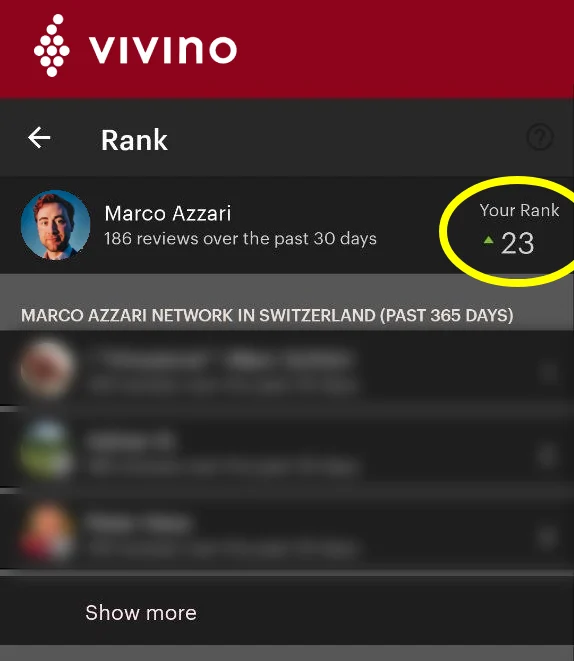
I am ranked in the top 30 Vivino users in United Kingdom — verifiable on the Vivino public ranking.
You will see me regularly at UK Wine events mainly London, and Ticino. Where UK wine operators talk to each other about what is actually happening on the floor.
The reason I built Wine CFO is simple. Five years ago I was building a wine list from scratch for a pizzeria in London. I felt the fear — too high and the prices won't sell, too low and there is no profit — while supplier reps breathed down my neck with bottles they needed to move. I watched a venue end up with 1,700 bottles in the cellar, GBP 100,000 of capital tied up, and a separate warehouse rented because the wine did not fit on-site.
That moment was when I understood the supplier-built list was the cause, not the cure.
So I took everything I had learned from F&B Management training, from Food Engineering, from the best F&B directors and sommeliers I had access to internationally, and I built the method I call: Wine Profit Engineering.
Others serve the wine. I architect the environment where your best bottles become legends.
My guarantee
90 days. Your wine sales go up — or I keep working.
After we finish the engagement, you have 90 days. If your wine sales have not moved compared to the baseline we measure on day one, I keep working at no extra cost until they do.
I work in fixed-price packages, not hourly fees. You know the price and the timeline before we start. No meter running, no surprise invoice.
T&Cs apply. Conditions are spelled out before signing, no fine print after the fact.
You have other options. Here are the problems with each of them.
I am not the only person in United Kingdom who claims to "help with the wine list."
I am the only one who helps you sell wine as an engineered profit centre.
Here are the problems with each of them.
| Generic alternative | What it actually does | What it leaves on the table |
|---|---|---|
| The supplier-built list (free service, supplier-portfolio-curated) | Provides selection at zero invoice cost. Wine arrives reliably. Relationships are warm. | Structural conflict of interest baked in (the same shape documented in the Subway / NYLJ vendor-rebate record). Pricing is cost × markup. No engineered design. No staff training. No sales tracking. The 50-60% blended beverage GP profile stays exactly where it was. |
| A freelance sommelier engagement | High-quality pairing logic, refined selection, label depth. Operator gets sommelier-grade taste. | Optimised for pairing artistry and prestige, not for measurable beverage gross profit movement. Typically delivered as a one-shot deliverable then exits. No measurement. No retainer continuity. No outcome guarantee. |
| Wine inventory software subscription | Counts bottles. Scans invoices. Shows analytics. Saves operator time on inventory. | Software is descriptive — it tells you what is happening. It does not redesign what is on the list, what it costs, or how it is presented. The operator has to translate the data into a redesign. The redesign work is exactly what does not get done. |
| DIY / cost × markup list management | Manager stays in full control. No outside fee. | This is the configuration the BTG margin gap is measured on. It is the leak in its purest form. |
| Generalist F&B consulting | Improves food-menu profitability when the consultant is good. | Wine economics (25-40% wine cost, occasion-driven purchase) differ structurally from food economics (28-35% food cost, need-driven purchase). Generic menu engineering does not adapt for wine-specific dynamics. |
| Sommelier training and certification for you or your staff (WSET, ASSP, CMS) | Builds genuine wine knowledge. Useful in service quality and front-of-house confidence. | The list does not get redesigned. The leak is structural; the certification is personal. The two address different layers. Time investment is high (120+ hours for the basic UK certification). |
Wine Profit Engineering: The Only Solution That Integrates Every Layer
There is no rule that says you have to pick this option. There is only the question of which option moves your beverage gross profit, and which option moves something else.
I would suggest you to
Frequently Asked Questions
- Q1. How long does the Wine List Checkup take?
- The form takes under 5 minutes to fill out. The full Checkup — analysis, written report, expert call — is delivered within 7 to 10 working days from submission.
- Q2. Do I need to commit to anything after the Checkup?
- No. The Checkup is a stand-alone deliverable. If you want to move forward with a Wine Profit Engineering project after seeing the report, we discuss it on the call. If you do not, you keep the report and we part ways. There is no automatic nor required sale.
- Q3. I have already tried a sommelier / a software / asking my supplier for new bottles. Why would Wine Profit Engineering be different?
- Each of those operates on one layer (selection, measurement, or inventory). Wine Profit Engineering integrates all of these layers. The "Why Not the Alternatives" table on this page lays out the difference for the different layers.
- Q4. My venue is small / my staff is small / my list is short. Is the Checkup still useful?
- Yes. The Checkup is calibrated to the venue. A 40-cover bistro with a 25-bottle list and a 200-cover hotel restaurant with a 200-bottle list both have the same structural problem (supplier-curated logic) but different leverage points. The report adapts.
- Q5. Do I have to change bottles or order new ones?
- No. All my Wine Engineering projects are built on top of the existing list. I do not change bottles or order new ones until is time to do that. I engineer the list to sell more wine. Rarely changing bottles is needed.
In a low-volume, high-cost market, profit comes from precision.
If your wine list is not engineered to sell, you are working harder than necessary for lower returns. Start where I start with every operator: the free Wine List Checkup.
Marco, the Wine CFO
Industry citations referenced on this page
Verified via web search 30 April 2026.
- Cornell Hospitality Research on menu engineering profit lift (10-15%) — Cornell Center for Hospitality Research / School of Hotel Administration; summarised on Cornell Chronicle and JigsawKraft.
- Cornell wine list study (Lynn & Yang) — "Study finds how restaurants can reap higher wine sales," Cornell Chronicle, December 2009. news.cornell.edu/stories/2009/12/study-how-restaurants-reap-higher-wine-sales
- Anchoring and decoy effect on menus — NineGuides menu pricing research (nineguides.com/menu/pricing-psychology); Mashed reporting on wine-list decoy architecture, drawing on Ariely / Wansink behavioural-economics literature.
- By-the-glass margin economics (75-80% gross margin; BTG = 60-70% of wine bar revenue) — Wine With Seth WineWiki (winewithseth.com); BusinessDojo wine bar revenue benchmarks (2026).
- UK hospitality 2025 insolvency data (2,900+ insolvencies, +30% YoY; 872 insolvencies Jan-Sep 2025) — joint Branchenbarometer from KOF Konjunkturforschungsstelle (ETH Zürich) and GastroSuisse; reported by MarketScreener Schweiz (October 2025), Watson, Blick. Named closures: Restaurant Strauss Manchester (15 GM points), Paradies Birmingham (15 GM points), Z am Park London, Maiengrün Hägglingen.
- Supplier conflict of interest in F&B vendor rebates (Subway USD 116M / 2019; Tim Hortons franchise litigation) — "Vendor Rebates: Franchising's Dirty Little Secret," New York Law Journal, December 2019 (law.com); Restaurant Business Online; Eater (June 2019); Inc. Magazine.